Godly Gains: Hacksaw’s Divine Gym Where Clusters, Cascades, and Zeus Reps Rewire the Global Multiplier
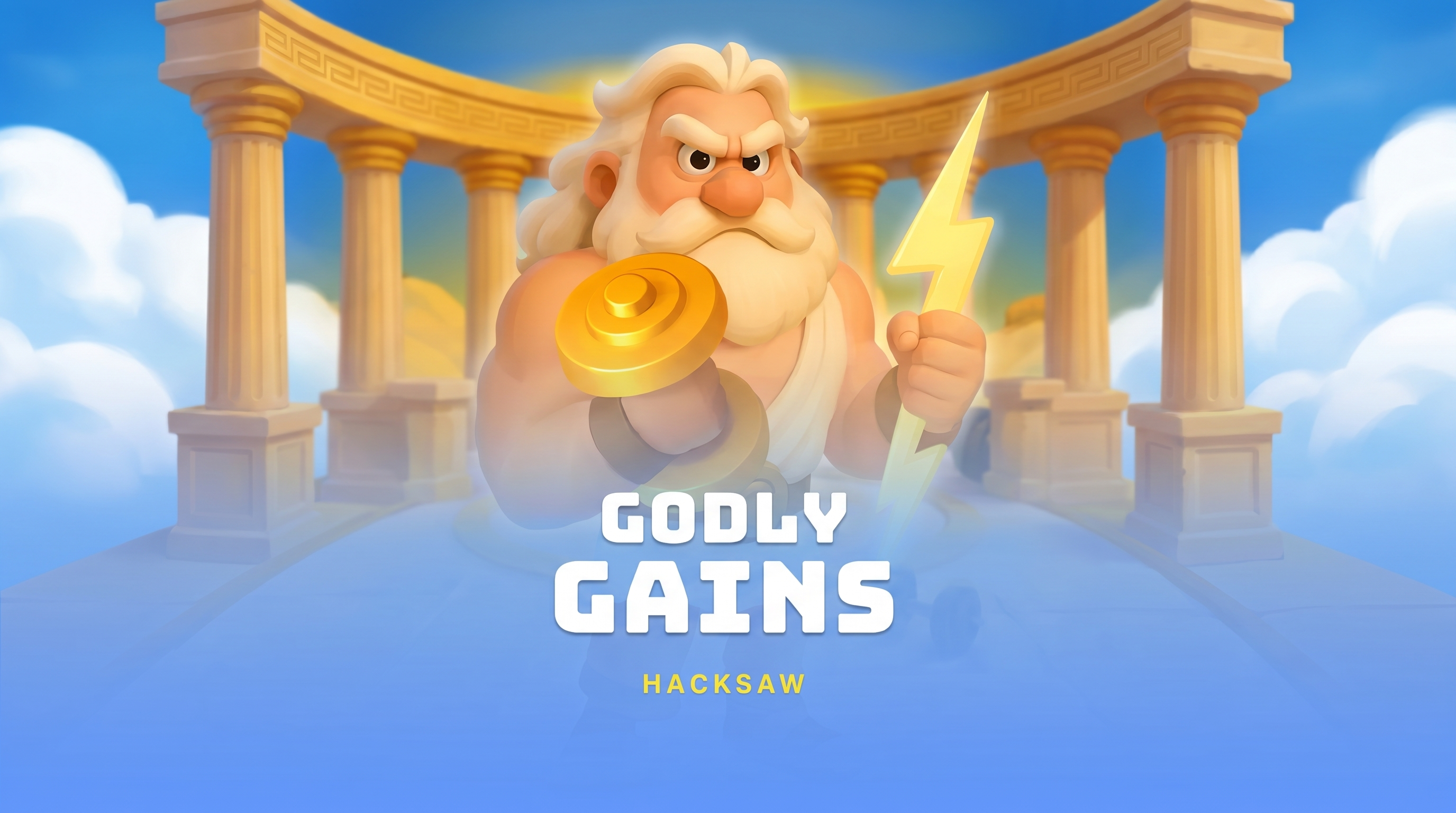
Godly Gains: Hacksaw’s Divine Gym Where Clusters, Cascades, and Zeus Reps Rewire the Global Multiplier
Godly Gains is Hacksaw (with Bullshark production fingerprints in public marketing) turning mythology into HIIT: a six-by-six cluster pays grid, cascades after every hit, God Mode symbols that either spray wild clusters or bend the global multiplier, and free spins where the multiplier and wild counter stop pretending to reset between spins. If you already speak Gates of Olympus multiplier grammar, you will recognise the escalation itch — except here the board is clusters, not scatter pays, and Zeus shows up like a personal trainer with a spreadsheet.
MonkeyTilt’s on-game sticker for this build reads 96.3% RTP, a 3.74% house edge, and volatility of 2/5 — softer on the bolt meter than Chaos Crew, which still does not make God Mode polite.
Clusters, cascades, and the global multiplier that resets at the wrong time
Public documentation describes five-or-more matching symbols connected horizontally/vertically as a win, followed by removals and drops until the chain ends. A global multiplier (starting 1x in marketing) applies to wins inside the same cascade sequence in the base game and resets when a new paid spin begins — check help for whether additive and multiplicative boosts stack in the order you think they do.
God Mode symbols in public copy either add wild clumps or push the global multiplier with additive and multiplicative boosts — exact menus belong in your info screen, not in a blog paraphrase.
Glorious Grind vs Divine Drills — two bonuses, same gym, different starting reps
Landing three scatters in public sheets triggers Glorious Grind with ten free spins and a wild counter that starts low; four scatters opens Divine Drills with the same spin count but a higher starting counter band — the point is intensity, not more spins. During bonuses, Thunderstrike symbols can feed the counter or multiplier path depending on rules, then convert to wilds — priority order matters when multiple specials land together.
If FeatureSpins or bonus buys exist in your jurisdiction, screenshot each RTP line beside its price — Hacksaw loves tiered contracts.
God Mode timing — why the same spin can feel rigged or generous
In public documentation, God Mode cannot co-exist with scatters on the same base-game spin — that rule prevents free bonus entry while also printing wild storms. Inside free spins, Thunderstrike and God Mode can collide with explicit resolution order (Thunderstrike first in many sheets). Learn that order like you learn dealer rules in blackjack — it is not trivia, it is ticket arithmetic.
Cluster psychology — centre mass versus edge sprawl
Cluster games reward dense premium blocks that survive cascades; edge-only wins often pay then vanish without feeding the multiplier ladder. Spend twenty demo minutes noticing whether your wins cluster or sprawl — sprawl without multiplier growth is how 2/5 sessions still feel expensive.
Cross-lobby comparisons
Against Fortune of Olympus, Godly Gains trades scatter-pay tumble theatre for cluster cascade theatre — different grid grammar, same multiplier escalation language.
Against Sweet Bonanza, this is connected clusters instead of anywhere pays — bankroll habits differ; paytable literacy does not.
Hand of Anubis is the right neighbour if you want darker Hacksaw cluster energy after cartoon Zeus — higher stress, different skin.
Bankroll truth for 2/5 divine reps
Volatility of 2/5 can still hurt if you chase super buys on tilt; 3.74% edge is middleweight honesty. Size bets for empty clusters, not for the one clip where God Mode fired twice in the same drop.
Turbo on cluster ladders is how you miss multiplier steps — manual cadence keeps receipts legible.
Session playbook — log cascade depth, not vibes
For twenty base spins, write max cascade depth and highest multiplier reached — if your histogram is flat, you are not “due” four scatters; you are seeing variance.
If you rotate into line slots after Godly Gains, Book of Dead is the cleanest control experiment — fewer moving parts, more scatter-to-feature clarity — useful when cluster fatigue sets in.
Screenshot scatter counts beside bonus names the first time you trigger each path — Glorious versus Drills is easy to misremember after midnight.
Run one full bonus with sound off and one with sound on — if audio is steering your stake, you now have evidence, not a hunch.
Who should spot the gym
Godly Gains suits players who want Hacksaw clusters, global multipliers, and progressive free spins where counters matter. It punishes anyone who confuses cartoon Zeus with soft math — the sticker still says house edge.
When Thunderstrike finally lines up with wild clumps and the global multiplier stops pretending to be decoration, Godly Gains earns the name: godly patience, gains you can weigh. That is the whole sermon — clusters, cascades, counters, cash.
Related Posts

Six New MonkeyTilt Picks: Pragmatic Farm Wheels and Anubis Tumbles, AvatarUX Mining, Hacksaw Duels, Nolimit Island Chaos, and Wicked Expanding Cred
Pragmatic farm wheels and Anubis tumble multipliers, AvatarUX roaming wilds, Hacksaw duel horror, Nolimit island xWays, and Wicked expanding spins — six fresh lobby picks …

MonkeyTilt Bonanza 1000: Pragmatic’s Candy Bomb Built for the Tilt Mafia
House-exclusive fruit, tumble clears, multiplier bombs stacking to the moon—MonkeyTilt Bonanza 1000 is Sweet Bonanza energy with Tilt branding.
Midas Fortune: PG Soft Paints Clusters Gold Until Wilds Won’t Leave
Touch the cluster, watch gold crawl, pray the wild graduates before the cascade goes cold. Midas Fortune is a 5×5 jewelry box where the bonus …

Le Fisherman: Smokey the Raccoon Takes Golden Squares to the Dock
Fishing with a raccoon sounds wholesome until Golden Squares start hoarding rainbows and buckets drain the whole dock. Calm 2/5 bolts on the card, 15,000× …